The empty seats cost the whole bill
Everyone who has driven out of Chennai or Bengaluru before a weekend away knows the negotiation. Leave at 4 and beat the rush, says one voice. The rush left at 3, says another. You pick a time, you pack the car, and somewhere past the toll you realise everyone else ran the same calculation and got the same answer. Brake lights to the horizon. The city empties like a theatre with one exit.
You cannot fix that road. But you can stop guessing about it.
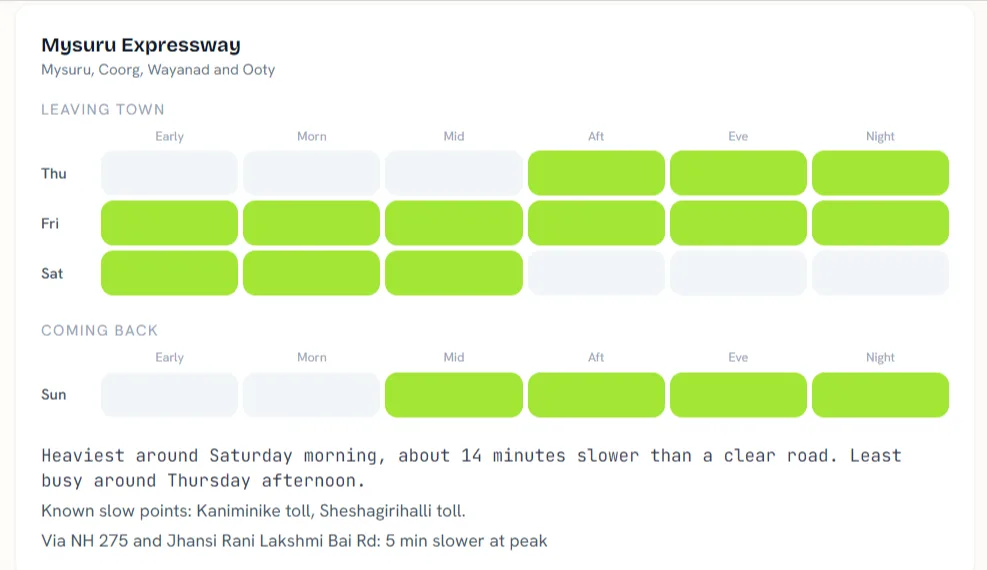
commuteimpact.com now carries a weekend traffic forecast for both cities: the four main exit corridors, every departure window of the coming weekend, each one marked with a band for how heavy the drive is likely to be. A scheduled engine reads Google’s traffic predictions ahead of time and publishes the outlook, so you can look on Wednesday and pick your window for Saturday. A maps app tells you how bad the road is once you are already in the car. This tells you before you load the boot. It is a forecast, not a promise. Chennai’s page is at commuteimpact.com/chennai/weekend-traffic, Bengaluru’s at commuteimpact.com/bengaluru/weekend-traffic, and each page knows its own holiday calendar, so Chennai will never announce a Karnataka-only holiday at you.
The forecast is the newest thing, but the number that stayed with me came from something else that went live this month: the first monthly traffic reports for both cities, computed from real commutes people ran through the calculator. July’s Bengaluru edition, at commuteimpact.com/bengaluru/traffic-report, says the median car commute costs ₹3,111 a month. That is from 149 car-commute calculations in a 606-commute sample, self-selected calculator users, not a census. Treat it as a reading of who measured, rather than a survey of the city.
Here is the part I keep turning over. The same data says that putting two more riders in that car saves about ₹3,049 a month and cuts the trip’s impact score by 64 percent.
₹3,111, median, to run the commute. ₹3,049 sitting in the empty seats.
The empty seats cost almost exactly the whole bill. Every car commute in that sample with room for two more riders is paying full fare for seats nobody is using. Not as a moral point. As arithmetic.
A few smaller things shipped alongside. Calculate a car, two-wheeler, or auto commute and the result now shows your own route’s travel time across a typical weekday, with the lowest-traffic window highlighted each way, and an estimate of the hours a month you get back by timing both legs well. Bengaluru’s three big corridors, Outer Ring Road, Sarjapur Road, and Whitefield, each got their own page with a live count of confirmed commutes. And the site itself got lighter: a first-time visitor on a phone now downloads about a third of the code they did a month ago, because commutes get planned on phones, usually in the minutes before leaving.
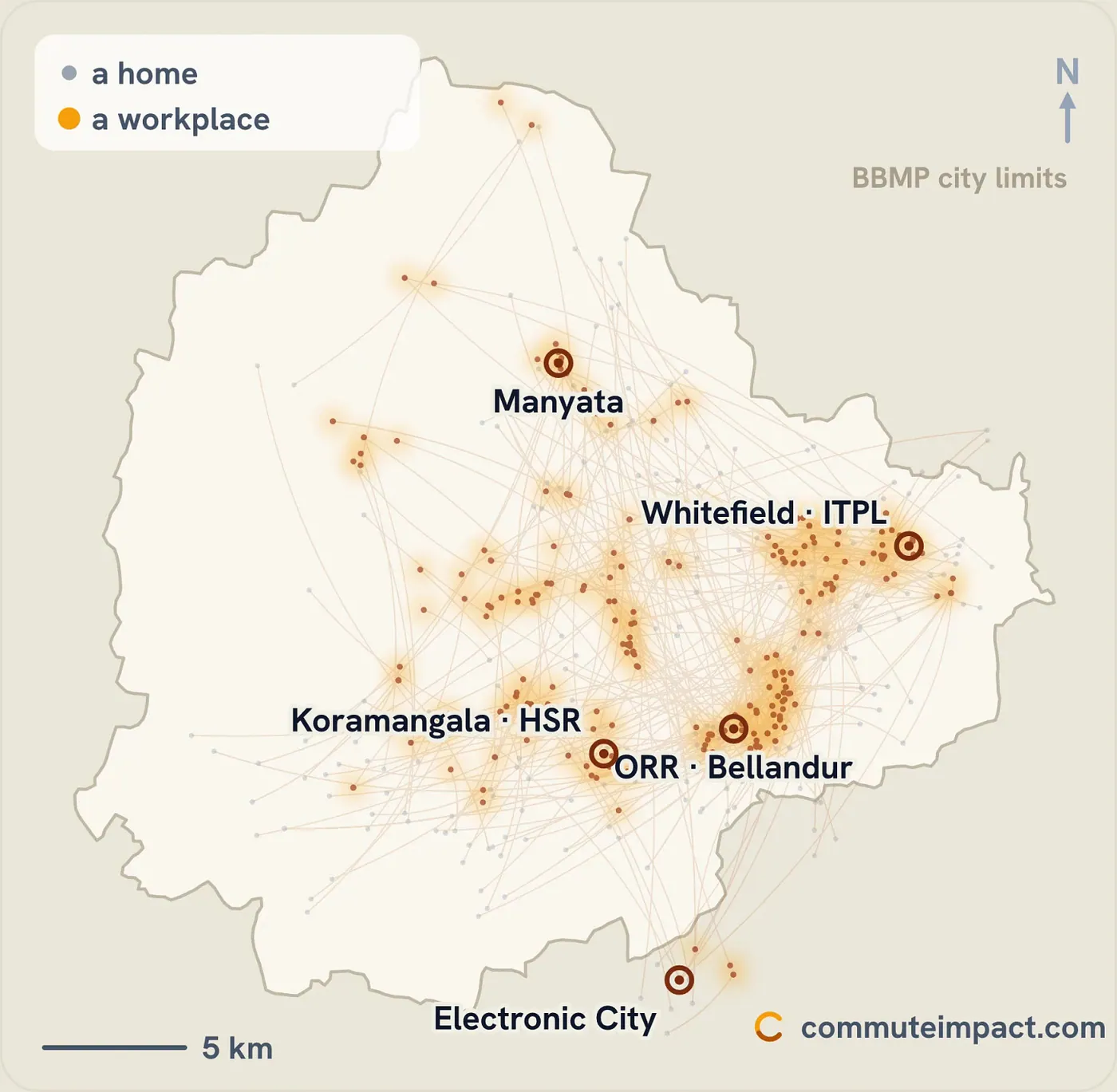
All of this runs on commutes people actually recorded, which means every month the reports get a little truer. The map behind it is drawn from 600 plus real Bengaluru commutes, faint lines from home to work; any route that would identify a lone commuter is never drawn. This project stays a side project, and that is exactly why it can afford to be patient: one city, one month, one honest number at a time.
The road out of the city will be heavy this weekend. It always is. The theatre still has one exit, and everyone still reaches it at the same time. But the crowd’s timing is written down now, and you can read it before you pick up the keys.
Have you ever done the arithmetic on your own commute, what it costs you in a month, in money and in hours? If you have, I want to hear the number.
P.S. The weekend forecasts are at commuteimpact.com/chennai/weekend-traffic and commuteimpact.com/bengaluru/weekend-traffic, and July’s Bengaluru report is at commuteimpact.com/bengaluru/traffic-report.