How Chennai Traffic Made Me Build a Calculator
The CIT Nagar signal in 2012 was my introduction to Chennai's beautiful chaos. Standing there in the rain, timing my sprint through auto-rickshaws and cars to reach the MTC bus door before it moved, taught me that commuting in this city is equal parts art, science, and survival instinct.
I'd position myself strategically, watching for the 23C or 1B approaching, then navigate the dance of grabbing onto the footboard while the bus was still moving. Sometimes I'd have to jump off an overcrowded bus and sprint to catch another at the same signal. It was a carefully choreographed routine that newcomers to Chennai learn or suffer through.
That was my entry point into what would become a 12-year observation study of how a city's transportation system reflects its people's relationship with collective responsibility.
The Evolution of Choices
My own commute journey mirrored Chennai's transformation. From those footboard days, I evolved to walking to Saidapet Bus Stop instead of standing at CIT Nagar, purely to get seats rather than hanging onto moving vehicles. Then came riding pillion with a friend from Tiruvallikeni to Mount Road, followed by the brief but enlightening phase of bringing my sedan from my hometown.
The car phase was revelatory. Sitting alone in a large vehicle, crawling through the same traffic I used to observe from bus windows, I felt the inefficiency in my bones. The car wasn't making me faster or happier. It was just isolating me from the city while burning money and contributing to the very congestion I was stuck in.
I sold the car and switched to a two-wheeler, and now primarily use the Metro for office commutes. But my preferred mode remains the auto-rickshaw for shorter trips. There's something meditative about experiencing Chennai through those open windows, watching the city unfold around you without the barriers of air-conditioning and closed doors.
The Entropy Observation
Over this decade, I've watched Chennai's traffic entropy increase steadily. Not just the volume, but the fundamental nature of how people move. Single drivers in Porsche Cayennes going to parks for morning walks. Fortuner SUVs navigating narrow streets for 2-kilometer gym commutes. People talking on phones while driving, slowing down entire traffic streams.
As someone with 13 years in media and storytelling, I've learned to observe patterns and translate them into accessible insights. The pattern I kept seeing was a disconnect between individual choices and collective impact. People understand they're part of the traffic problem, but they don't quantify it. The costs remain invisible.
I understand the need for personal vehicles. Chennai's geography, weather, and infrastructure make cars and two-wheelers necessary for many trips. But where's the line? When does personal convenience cross into collective harm?
The AI Experiment
The idea for a traffic impact calculator had been floating in my mind for months, but I kept dismissing it as too complex to build. Then I decided to experiment: how far could I push AI development tools to create something production-ready?
Working weekends and evenings over two weeks, I built the entire application using Claude, ChatGPT, and Replit. The process was fascinating and frustrating in equal measure. AI tools could generate sophisticated React components and complex algorithms, but they sometimes gave conflicting architectural advice. There were moments when everything broke and I had to rebuild from scratch, which tested my patience but taught me immense amounts about modern development.
The technical challenge wasn't just coding. It was translating Chennai's unique traffic reality into data. How do you quantify the congestion multiplier for Anna Nagar during evening peak hours? What's the real emission factor for a Honda Activa navigating Nungambakkam? The AI tools needed constant guidance about local context and domain knowledge.
The Tool's Philosophy
The Chennai Traffic Impact Calculator that emerged isn't designed to preach or shame anyone. My own commute scores 44 out of 100 on the tool. I'm imperfect, like everyone else. But I see an imperfect world trying to do perfect things, and that's okay.
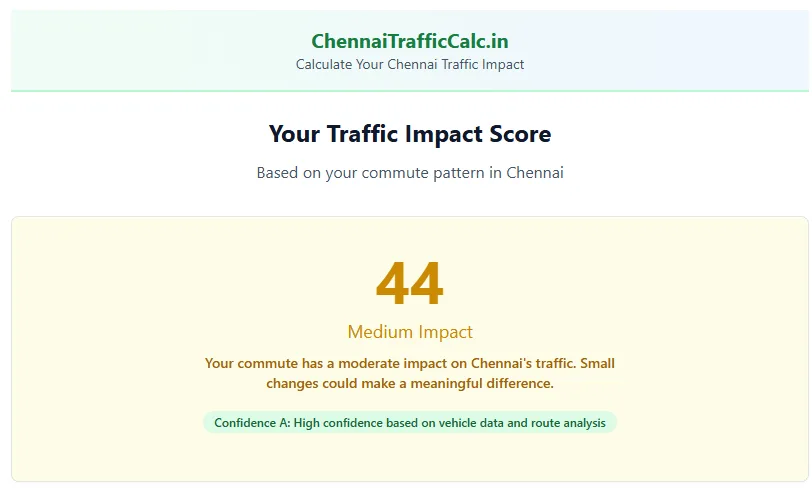
The calculator shows people their environmental impact score, monthly CO₂ emissions, costs, and time spent commuting. More importantly, it suggests practical alternatives with quantified benefits. A 10-kilometer car commute might score 65/100 impact, cost ₹180 per day, and emit 2.8kg of CO₂. The same trip via Metro scores 25/100, costs ₹50, and emits 0.4kg of CO₂.
The goal isn't to eliminate personal vehicles but to make the invisible costs visible. When someone sees they're spending ₹4,800 per month on car commutes versus ₹1,300 on Metro for the same route, mindfulness emerges naturally.
Individual Accountability in Collective Problems
Chennai's traffic problem feels insurmountable because it's a collective action challenge. Everyone is acting rationally from their individual perspective, but the collective outcome is irrational for everyone. The solution isn't top-down policy changes alone, but also bottom-up awareness.
Self-accountability might be the key to societal change. Not guilt or shame, but honest introspection about the ripple effects of our choices. The calculator is designed to facilitate that introspection without judgment.
I'm not extensively environmentally conscious in all areas of life. I'm at peace with nature's entropy and focus on the things I can actually influence. This tool represents one small area where individual awareness might drive collective improvement.
What I've Learned
Building this tool taught me several things about Chennai, technology, and human behavior. People do want to make better choices when given clear information. The city has decent public transportation infrastructure that's underutilized partly due to awareness gaps. AI tools can democratize software development for domain experts who understand problems but lack traditional coding skills.
Most importantly, I learned that individual tools can spark conversations about collective challenges. The calculator isn't trying to solve Chennai's traffic problem single-handedly. It's trying to help people see their role in it more clearly.
The tool is live at chennaitrafficcalc.in for anyone curious about their commute impact. I'm planning to open-source the approach and hope other Indian cities might adapt it for their contexts.
Closing Thoughts
I still take autos for short trips because there's something magical about experiencing Chennai through those open windows. I still ride my two-wheeler because I genuinely enjoy it. The goal isn't to eliminate all personal mobility but to right-size our transportation choices.
Chennai is at an interesting inflection point. We have expanding Metro networks, improving bus systems, and growing environmental awareness among residents. But we also have increasing prosperity leading to more car ownership. The city's future transportation culture isn't predetermined.
Tools like this calculator won't solve everything, but they might help tip the balance toward more conscious choices. Individual accountability remains the foundation of collective change, whether we're talking about traffic, climate, or any other shared challenge.
The footboard days taught me that Chennai commuting requires strategy, patience, and community awareness. Those lessons apply to building sustainable transportation systems too.