Contradictions Collapse: The Era of Liquid Content Without Solid Journalism
If you come from an editorial or journalism background and move into news product management, you’ll encounter this speed-breaker often: self-contradictions.
The journey feels like driving a highway lined with toll gates, one after another. Each toll gate represents something—rise and fall of social media traffic, pay-per-article, subscriptions and so on.
Every toll gate demands absolute truth as its fee. It’s here that you encounter multiple sides of same coin - journalism, business needs, user value, and more. Coming from an editorial background, my north-star concern has always been the impact a story creates. But as a news product manager, I now think about the business, the product, the users and the content itself. As time goes on, contradictions develop.
Is subscription as a business model catering only to a small fraction of financially privileged audiences? Yes. But is it helping journalism thrive? Also yes.
Does a paywall block access to stories people deserve to know? Yes. But is it funding good journalism? Yes again.
Do I personally like blocking content with paywall? No. But is it necessary. Yes!
When each toll gate demands clarity and truth from yourself, What do you do? You look at numbers. You read the stories. You build things. You choose a path that promises a collective win. The absolute truth is experimentation.
When Facebook’s video initiative took off, most publishers were eager to pivot toward video. The numbers were promising, and the opportunity seemed irresistible. Our feeds were soon flooded with video content. But from a news product perspective, this pivot came at a cost: reallocating editorial resources, and losing control of the audience your content attracted. At the same time, the reach Facebook offered was unparalleled. (Click here if you want to know what eventually happened in FB’s video initiative)
This was a classic contradiction: do you prioritize ownership and control, or chase distribution and visibility? You weigh the trade-offs, make peace with uncertainty, and move forward.
The same holds true for pay-per-article models. On one hand, they make quality journalism more accessible at a feasible cost. On the other, they introduce significant mental friction for users who must decide whether each story is worth their money. My solution? Keep experimenting to reduce that friction and make the choice seamless for users.
Even with analytics and instrumentation, what seems like absolute truth often reveals hidden contradictions. I might trust the metrics I see on my dashboard daily, but when I dig deeper, I uncover biases—both in the data and in my own interpretations.
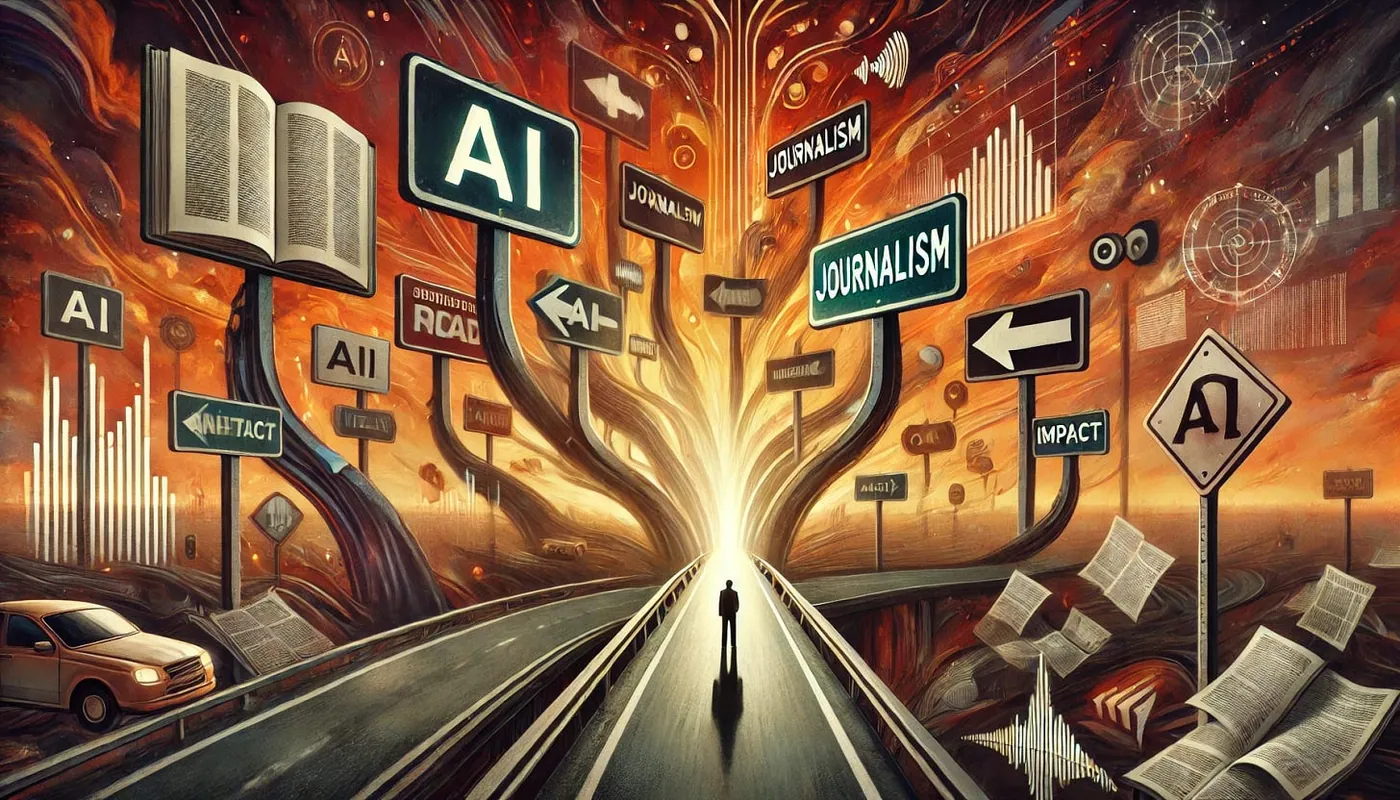
(AI Generated Image)
Every toll gate I’ve passed so far has tested my ability to balance contradictions, weigh trade-offs, and adapt to uncertainty. Now, as the landscape of journalism and news product management evolves, a new challenge looms ahead—one that promises to redefine the very nature of storytelling and its impact.
We’re at a crossroads. There’s a new signpost:
Turn left for AI. Turn right for AI. Go straight for AI. Go back for Journalism.
This toll gate feels like the ones you encounter on a holiday weekend—overcrowded, chaotic, deafening, and utterly consuming.
Finally, I inch toward the toll cashier, and he demands, “Pay the toll with an absolute truth if you wish to continue your journey.”
I say:
“AI will dilute solid journalism into less-impactful, bite-sized liquid content optimized for distribution, traffic, personalization and engagement. But it will also help good journalism reach deserving audiences at a lower cost. The impact of good journalism may become collateral damage—but it’s too early to tell. For now, it’s time to experiment and see for myself. My contradictions are collapsing. I can be right and wrong at the same time. But as a news product manager, my job is to preserve the impact of journalism in whatever form of liquid content it takes.”
The cashier stares, perplexed, as the cars behind me honk impatiently. Begrudgingly, he lifts the barrier, and I move on.
As I drive, I think about what I meant by impact.
Editorials and journalists operate with an intent to impact. When someone creates a strong piece of journalism, it’s done with the hope of making the reader feel a certain way. That’s why storytelling is an art. But as journalism morphs into “content” or even “liquid content,” how do we ensure its intent—and impact—are preserved?
If AI and related tech excel at personalization and liquid/multimodal content, it means the same story could be reimagined in countless ways, tailored to each consumer. While this might solve a user’s job to be done (JTBD) and boost business, is it the right path for journalism-driven organizations?
Take this story as an example. I stumbled upon it several years ago, and I still remember the emotions I experienced when I read the entire piece. But what if one person consumes only the video, another only the summary, and a third only the audio? Each format brings a different emotional weight. While multimodal content can expand reach, does it truly preserve the impact the story was meant to have? At what point does a ‘story’ lose its essence and become just another piece of ‘content’?
If we assume any format can deliver the intended impact, why do people still seek out printed books for deep understanding? Why do long-form pieces still hold value in an age of AI-generated summaries and audiobooks? If the impact of solid journalism is guaranteed in any form of liquid content (AI-driven or summarized content), then should I price both the same?
Maybe written long-form content offers better value—both for journalism and its consumers. Or maybe it’s primal, a deep-rooted human need. We come from a species that carved our histories into stone, told future generations about wars fought with arrows, and wrote poems as inscriptions. Now, we scroll AI-generated summaries on palm-sized screens. Are we lazy creators—or lazy consumers?
Contradictions collapse.
There’s only one absolute truth: embrace disorder, take the leap, learn along the way, and offer those lessons as the ‘absolute truth’ at the next toll gate.
Thoughts for Conversations:
Why is media more obsessed with AI than the actual impact of journalism? Are we overcompensating? Reacting instead of responding? Or is this my filter bubble?
Globally, what’s the collective investment in hiring field reporters and journalists compared to AI initiatives?
Is the rise of AI in newsrooms and the exodus of journalists from large organizations to become independent correlated without causation? Independent voices are vital for democracy, but they risk manipulation. Legacy organizations offer structures to verify information and nurture talent—but they too falter. Remember when a news channel’s journalist read a parody tweet impersonating the Indian Prime Minister on live TV as actual news? This is the gold standard of TV journalism in India, today. Sure, mistakes happen—but still…!
Rural folks know their local councillors and panchayat heads but not ministers. Elites don’t know their ward numbers but can call a minister in minutes. Until journalism bridges this inequality, there will never be a truly successful news model.
The information ecosystem faces a high-entropy situation. As context dilutes, highly concentrated systems gain value.
And to you, my reader—here’s a question for you: What holds more value in your memory—when you were deeply engrossed in the pages of a printed book? or when you were immersed in listening to an audiobook?
P.S. The title 'Contradictions Collapse' is inspired by the debut studio album of the same name by the Swedish metal band Meshuggah. A nod to how their intense, complex music aligns with the layered contradictions I’ve explored in this piece.